
K Garira


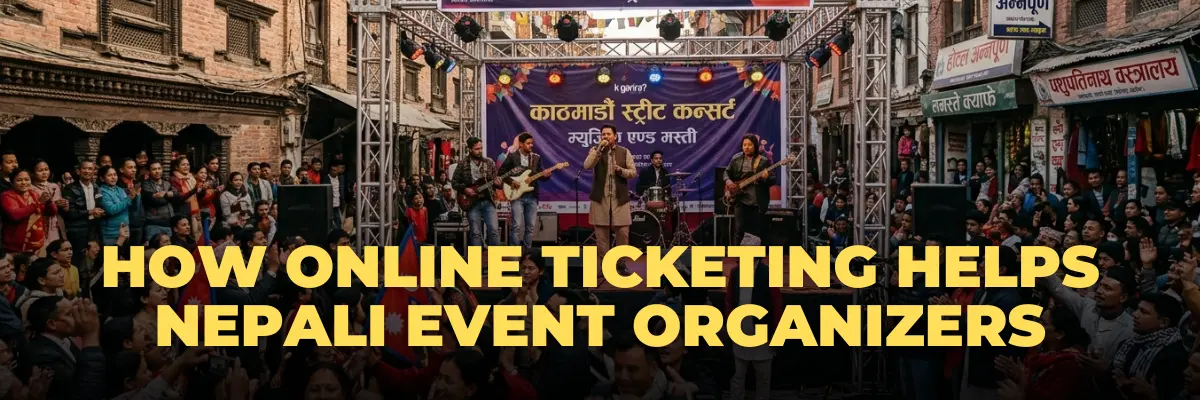
Selling out an event in Nepal used to mean printing tickets, finding physical distribution points, managing cash collections from multiple locations, and hoping the word spread fast enough through advertisements and word of mouth to fill seats before the date arrived. The process was slow, the data was thin, and the margin for error on attendance estimates was wide.
Online ticketing changes most of that. Not by replacing the work of promotion, but by removing the friction between someone deciding to attend and actually securing their seat. In a market where impulse decisions drive a significant share of ticket purchases, the gap between intent and action is where sales are lost. An event ticketing platform in Nepal that closes that gap captures those sales.
This article covers how online ticketing helps Nepali event organisers sell out faster, what specific capabilities drive that outcome, and why the shift from physical to digital ticketing is now a practical necessity rather than a forward-looking option for organisers who want to maximise revenue.
Instant Access Drives Quick Purchases
The most direct way online ticketing increases sales velocity is by collapsing the time between a buyer's decision to attend and the completed purchase to under two minutes. A potential attendee who sees a social media post about an event, clicks through to the ticketing page, and completes payment on their phone before the impulse fades is a sale that physical ticketing structurally cannot capture.
This matters more in Nepal's events market than the numbers alone suggest because the social media-driven discovery of events is the primary awareness mechanism for most events outside the top-tier concert category. A post that generates interest at 11pm on a Tuesday reaches people when no physical ticket outlet is open. An event ticketing platform in Nepal that is accessible at that moment captures those buyers. Physical ticketing defers them to the next day, by which time the impulse has often cooled.
The mobile payment infrastructure that makes this possible has expanded significantly in Nepal. eSewa, Khalti, ConnectIPS, and bank transfers are all familiar to a large and growing segment of the population that attends ticketed events. The technical barrier to completing an online ticket purchase has largely been removed for the urban demographics that constitute most event audiences.
Kgarira provides the platform infrastructure that converts this accessibility into completed sales, with a checkout experience designed for the mobile-first audience that drives Nepal's event discovery.
Real-Time Sales Data Changes How Organisers Work
Physical ticketing leaves organisers working with lagging information. Sales data from multiple distribution points arrives late and in inconsistent formats. Decisions about marketing spend, promotional pushes, and capacity management are made on stale information.
An event ticketing platform in Nepal that provides real-time sales dashboards changes the organiser's operational relationship with their event from reactive to proactive. When an organiser can see exactly how many tickets have been sold, which categories are moving fastest, where buyers are coming from, and what the daily sales velocity looks like, they can act on that information while there is still time to affect the outcome.
An event that is 40% sold two weeks out with a consistent daily sales rate is in a different position from one that is 40% sold with a declining rate. Real-time data makes that distinction visible and actionable. The organiser with declining velocity can push a targeted promotional campaign, add an early bird discount to stimulate urgency, or adjust their marketing channel mix while there is still a meaningful runway before the event date. The organiser without that data does not know there is a problem until it is too late to address it.
Sales data also informs post-event decisions. An organiser who can see which promotional channels drove the most conversions, what the peak sales period was, and which ticket categories sold out first has the information to run the next event more effectively. This compound improvement across events is what separates consistently well-attended events from those that fluctuate unpredictably.
Reducing No-Shows and Improving Attendance Reliability
Purchased tickets that result in no-shows are a direct revenue and atmosphere problem. Events that look poorly attended despite strong advance ticket sales create a poor experience for those who did attend and damage the organiser's reputation for subsequent events.
Online ticketing platforms reduce no-shows through automated communication. Confirmation emails at purchase, reminder notifications as the event approaches, and day-of reminders via SMS or push notification keep the event present in the buyer's awareness and reduce the rate at which purchased tickets go unused.
Digital tickets also simplify the attendance experience for buyers. A QR code on a phone that scans at entry is faster and more reliable than a physical ticket that can be lost, damaged, or forgotten. Faster entry processing reduces queue times that frustrate attendees and affect their experience of the event from the first moment of arrival.
For organisers using Kgarira, the door management tools that pair with the ticketing platform allow efficient entry scanning, real-time attendance tracking at the door, and identification of duplicate or fraudulent entries. This operational efficiency at entry is a direct benefit of having a centralised digital ticketing system rather than manual ticket collection.
Creating Urgency That Physical Ticketing Cannot
One of the most effective drivers of ticket sales velocity is scarcity combined with transparency. When buyers can see that only a limited number of tickets remain in a specific category, the urgency to purchase before the option closes is a genuine motivator.
Physical ticketing cannot communicate scarcity in real time. Online ticketing platforms can display remaining inventory, show when a tier has sold out and prompt consideration of the next available option, and activate countdown timers or limited-time offers that create temporal urgency alongside scarcity urgency.
An organiser who releases tickets in tiers, with early bird pricing giving way to standard pricing at a defined threshold, uses the ticketing platform to do work that physical sales cannot. The buyer who hesitates on early bird pricing and then sees the tier close out is more motivated to act on the standard tier than they would have been if pricing was flat throughout. The platform communicates this transition automatically without requiring the organiser to manually push announcements.
This tiered release approach also smooths the sales curve. Rather than a rush at launch and a long flat middle, tiered pricing creates multiple sales peaks that maintain momentum and social media visibility across the full pre-event period.
Reaching Beyond Geographic Boundaries
Physical ticket distribution in Nepal is concentrated in Kathmandu with limited reach into Pokhara and other urban centres. An event in Kathmandu that would draw attendees from Pokhara, Chitwan, or from Nepali diaspora abroad cannot practically sell physical tickets to those buyers.
An event ticketing platform in Nepal with online sales removes geographic constraint entirely. A buyer in Pokhara planning a trip to Kathmandu for a concert can purchase a ticket the moment they decide to attend, without any coordination with a distribution point. A Nepali living abroad who wants to attend an event during a home visit can purchase weeks or months in advance.
This geographic reach does not automatically translate into sales without promotion, but it removes the structural barrier that previously meant any buyer outside a physical distribution radius was effectively excluded. For events with national or international appeal, this expanded reach is a direct revenue opportunity that online ticketing makes accessible for the first time.
Kgarira's platform is accessible across devices and payment methods relevant to Nepali buyers regardless of location, ensuring that the expanded geographic reach translates into completed purchases rather than abandoned intent.
Building an Audience for Future Events
Every completed ticket purchase through an online platform generates a buyer record. Name, contact details, event preferences, and purchase history accumulate into an audience database that has value beyond the individual event.
An organiser who has run three events through Kgarira has a database of buyers with demonstrated willingness to pay for ticketed events. For the fourth event, this database is the highest-conversion marketing channel available. A direct notification to previous buyers about a new event consistently outperforms cold social media advertising because it reaches people who have already done the thing once.
Physical ticketing generates no equivalent database. Cash transactions at collection points leave no record of who the buyer is. The organiser finishes the event with no direct connection to the people who attended and must rebuild audience awareness from scratch for every subsequent event.
The database that builds through online ticketing is a long-term asset for any organiser who runs events regularly. It compounds across events in the same way that real-time data improves operational decisions, turning each event into an investment in the next one rather than a standalone exercise.
The Problem with Physical Ticketing in Nepal
A buyer who wants to attend an event has to know where to find a physical ticket, get themselves to that location during operating hours, carry cash or arrange payment, and then hold onto the ticket until event day. Each of these steps is a point where the sale can fall through. The buyer forgets to go. The distribution point is in the wrong part of the city. The cash is not available at the moment of intent. The ticket gets lost.
For the organiser, the problems ran parallel. Without centralised sales data, accurate attendance tracking was impossible until doors opened. Revenue was dispersed across multiple collection points and consolidating it required coordination. Sold-out events were identified only when physical stock ran out, by which point the momentum of demand could not be redirected into a waiting list or future event promotion.
The Nepali events market has grown significantly. Concerts, corporate events, comedy shows, workshops, sporting events, and cultural festivals all compete for audience attention and disposable income in an increasingly crowded calendar. Organisers who run tight operations with accurate data consistently outperform those who do not.
Kgarira: Nepal's Event Ticketing Platform
Kgarira provides the online ticketing infrastructure that Nepali event organisers need to sell faster, manage smarter, and build audiences that persist beyond individual events. The platform handles ticket sales, payment processing through Nepal's major digital payment channels, door management, real-time analytics, and buyer communication in one integrated system.
For organisers running events of any scale, from intimate workshop sessions to large-scale concerts, Kgarira removes the operational friction that slows physical ticketing and replaces it with a platform built for how Nepal's event audience actually discovers and purchases tickets today.
FAQs
1. What is an event ticketing platform in Nepal and how does it work?
An event ticketing platform is a digital system that allows event organisers to list events, set ticket categories and pricing, and sell tickets directly to buyers online. Buyers complete purchases through the platform using digital payment methods and receive digital tickets, typically as QR codes, which are scanned at entry. The organiser accesses real-time sales data, manages capacity, and handles buyer communication through the platform. Kgarira provides this full functionality for Nepali event organisers.
2. Which payment methods do Nepali buyers use on online ticketing platforms?
The primary digital payment methods among Nepali event audiences are eSewa, Khalti, ConnectIPS, and mobile banking transfers. Kgarira integrates with these payment channels to ensure buyers can complete purchases through their preferred method without friction. The availability of multiple familiar payment options is a direct factor in conversion rates, as any unsupported payment method is a reason for a potential buyer to abandon the purchase.
3. Is online ticketing suitable for small events and workshops, not just large concerts?
Yes. Online ticketing delivers the same core benefits at any scale: instant purchase capability, real-time attendance tracking, automated buyer communication, and a buyer database for future events. For smaller events and workshops where capacity is limited and each ticket sale matters more, the data visibility and reduced no-show rates that online ticketing provides are particularly valuable. Kgarira accommodates events across scales from small workshop sessions to large concerts.
4. How does online ticketing reduce ticket fraud and duplicate entry?
Digital tickets issued as unique QR codes can only be scanned once at entry. The door management system marks each scanned ticket as used and flags any attempt to use the same code again. This eliminates the physical ticket duplication and fraudulent printing that are relatively straightforward with traditional printed tickets. The organiser has a complete record of all valid ticket codes and can verify any entry in real time at the door.
5. How does Kgarira help Nepali event organisers build their audience over time?
Every ticket purchased through Kgarira generates a buyer record with contact information and event preference data. Organisers can communicate directly with previous buyers about upcoming events, creating a direct marketing channel that consistently outperforms cold audience outreach. Over multiple events, this buyer database becomes one of the most valuable assets an organiser has, reducing the cost and effort required to fill seats for each new event and building a community around the organiser's programming.
Share this post
K Garira